Showing posts with label Books and Authors. Show all posts

Tuesday, June 28, 2011

Summer Travel, Conservative Reading

My husband was gone for another month recently for more army training. They spent some days in the field where he got to put his new uniforms to the test, not with life or death supplies like our soldiers overseas, but things important to him nonetheless.Jon's Army gear Because I have a public blog I don’t like to broadcast the fact that he’s gone, when he’s gone, but I sure am glad when he’s home again.

Things have been pretty busy around here preparing for my daughter’s wedding. One thing we did was go down to New Orleans to meet my future Son-in-law’s family. IMG_4271It went well. I got along great with his mom, it felt to me like we were old friends. And to my surprise and satisfaction, his dad is another one of us crazy conservative types like me. Our conversation went from the presidency to voting, to scripture to great books we’ve read. Once you’ve realized that you have many of the same favorite books, then you really know a lot about someone (i.e. they are as awesome as you are, haha). So that went well.

Speaking of favorite books, the long out of print “An Enemy Hath Done This” by Ezra Taft Benson is back in print by a company named Freedom-Books. As a former Secretary of Agriculture under Dwight D. Eisenhower, Ezra Taft Benson fought against farm subsidies from the government in order to preserve a free market farming system back in the 50’s. He later became the President of the Church of Jesus Christ of Latter Day Saints. Ezra Taft Benson warned against forces in society that were seeking to overthrow the freedom of this country. This book contains many speeches to the Boy Scouts Of America and other organizations, on constitutional topics and is very relevant today, though the facts and figures have changed dramatically over the years. (I think most of the speeches were given in the ‘60’s). I ordered a new copy recently because I had given mine away. I need a few more! 176 So if you haven’t heard of it or read this book, check it out. It is one of my ‘MUST READ’s’.

-Lynnae

Saturday, April 16, 2011

Atlas Shrugged Part 1

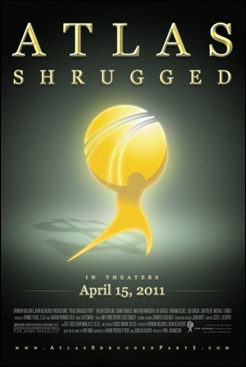
Atlas-Shrugged-Movie-Poster Opening night at Atlas Shrugged was great. We went to Lincoln Square in Bellevue Washington. We got there early and it’s a good thing because the house was packed. I wore my Atlas shrugged tee shirt and a chain bracelet, though it wasn’t like the modern bracelet designed in the movie.

My friend and I have read the book . I’ve read it three times now.  Our husbands hadn’t. So they had an interesting take. They could follow the story well and liked it a lot. I liked it, because I’m a fan, but missed a lot of things from the book. (For example, a said ‘It left out their entire childhood’ and my husband got thins look of horror in his eyes and said ‘Thank goodness!’) So their you go. The adaptation made this book accessible to a lot of people, and I’m sure many will go on to read the it.

The movie avoids the  atheist aspects of objectivism, and greatly downplays the sometimes violent sexuality that is hinted at, though not described in detail, in the book. Occasional conversations had to contain information that is set up over several chapters in the book, so occasionally the dialog seemed a bit unnatural.

Most the things I didn’t like were changes made for no reason as far as adapting the novel to film. Some of these are…..

Hank Rearden found the motor, instead of Dagny finding it when they were visiting the factory together.

The bracelet scene. Lillian's disgust for the bracelet was evident, but she wasn’t making fun of it too here friends at the party like we read in the novel. She said she would trade with anyone but there were no takers. The Dagny confronts her and trades the bracelet for her diamonds. That is one of my favorite scenes in the book, and in the movie it seemed to be just a hint that Dagny liked Rearden, not her appreciation for the intelligence, work, and prosperity Rearden Metal represented.

Fransisco just wasn’t cool enough. He looked sloppy. My husband thought he was perhaps some kind of anti-Che type character, which in a sense is right, but in Atlas shrugged he is tall and lean, and the chubby faced sloppy look is reserved for the looters and the moochers.

And over all I would have preferred a 1940’3 period piece.

What I loved…..

Dagny was great. I wish she would have been brunette like in the book, but she was still great. Rearden and Jim were also very well cast.

If you have to adapt it to present day, they did a great job explaining why the trains were still relevant.

The government, the regulations, and the crooked businessmen who are dealing with politicians rather than relying on the quality of their products are portrayed so well.  So is each blow to Rearden as he tries so hard to be successful and is crushed at every turn by each new government bill. It made my heart ache with frustration.

Rearden’s family and Dagny’s brother Jim were just great in their awfulness. What a slimy bunch!

That last scene. Oh-it was great. It really captured the sense of frustration and futility Dagny was feeling.

So there’s my review. Soon my daughters will be home from college and I’d like to take them to see it too. I’m so glad this movie was finally made. I loved the applause at the end of the show.

When does part two come out????

-Lynnae
Friday, February 11, 2011

Atlas Shrugged Movie Trailer

The movie trailer for Atlas Shrugged Part One has been released. This is a much anticipated movie and I hope it can live up to the novel.

Watch now…..‘Atlas Shrugged Trailer’.

( My biggest disappointment in the movie is that it isn’t done in a late ‘40’s style. Ahhh, well.)

Even though I have a few core arguments against Objectivism in general, I think the philosophy regarding government controls of the market is spot on. I am sick of the moochers and looters.

I am a Christian and do believe in helping others, which you may say is contrary to the philosophy in Atlas Shrugged. However I would say that the detrimental effects (on both the giver and the receiver) come when you are forced or coerced to support someone else. Helping others because you wish to is barely touched on in the book, and not very thoroughly handled in my opinion. But the main themes are excellent. I love the appreciation for hard work, ideas, and the genius that makes the country great. It’s sad to see that drive squashed in Atlas Shrugged and realize it’s happening today in real life.

-Lynnae

Friday, January 14, 2011

Atlas Shrugged Video Contest

Check out this brilliant winner of the Atlas Shrugged video contest!

By Reg Schickel

For other runner-ups look here.

-Lynnae

Wednesday, June 23, 2010

Thomas Sowell

Please read Thomas Sowell's wonderful column from yesterday, "the Degeneration of Democracy". I am a huge Thomas Sowell fan and this article was fantastic.

Thomas Sowell

-Lynnae

Tuesday, June 23, 2009

More Quotes On Socialism

“The effect of Socialist doctrine on Capitalist society is to produce a third thing different from either of its two begetters- to wit, the Servile State” -Hilaire Belloc, The Servile State1913: 3d ed., 1927

I wanted to discuss another little passage from Hayek’s The Road to Serfdom today.

“We have progressively abandoned that freedom in economic affairs without which personal and political freedom has never existed in the past. Although we had been warned by some of the greatest political thinkers of the nineteenth century, by De Tocqueville and Lord Acton that socialism means slavery, we have steadily moved in the direction of socialism. And now that we have seen a new form of slavery arise before our eyes [referring to Nazi Germany], we have so completely forgotten the warning that it scarcely occurs to us that the two things may be connected.

“How sharp a break not only with the recent past but with the whole evolution of Western civilization the modern trend toward socialism means becomes clear if we consider it not merely against the background of the nineteenth century but in a longer historical perspective. We are rapidly abandoning not the views merely of Cobden and Bright, of Adam Smith and Hume, or even of Locke and Milton, but one of the salient characteristics of Western civilization as it has grown from the foundations laid by Christianity and the Greeks and Romans. Not merely nineteenth and eighteenth century liberalism*, but the basic individualism inherited by us from Erasmus and Montaigne, from Cicero and Tacitus, Pericles and Thucydides, is progressively relinquished……

…….. During the whole of this modern period of European history the general direction of social development was one of freeing the individual from the ties which had bound him to the customary or prescribed ways in the pursuit of his ordinary activities. The conscious realization that the spontaneous and uncontrolled efforts of individuals were capable of producing a complex order of economic activities could come only after this development had made some progress. The subsequent elaboration of a consistent argument in favor of economic freedom was the outcome of a free growth of economic activity which had been the undesigned and unforeseen by-product of political freedom.” (Italics are mine.)

- F.A. Hayek, The road to Serfdom, pg.16-19

* Remember at this time the word liberal referred to those in favor of a free market individualism.

Are we ready to give up such a heritage? Are we ready to trust the political impulses of Barack Obama and his cronies over the great thinkers of the ages and the benefits of the free market that we can see with our own eyes? Are we ready to give up the freedom we have for a system that has FAILED every time it has been tried?

I would also like to call attention to the last sentence that I italicized. It is easy for our opponents to claim that our capitalist tendencies come from greed and nothing more. I do find it frustrating that our way of living has become called capitalism, when that is merely an outgrowth, and a way of describing the system of market a free society is able to produce under a laissez faire government. But the free society is the point, and offers many opportunities for pursuing life, liberty, and happiness beyond just the pursuit of capital.

-Lynnae

Tuesday, June 16, 2009

Alexis de Tocqueville On Democracy

JORDAN ON CURB WITH FLAG2001

“ Democracy extends the sphere of individual freedom, socialism restricts it. Democracy attaches all possible value to each man; socialism makes each man a mere agent, a mere number. Democracy and socialism have nothing in common but one word: equality. But notice the difference: while democracy seeks equality in liberty, socialism seeks equality in restraint and servitude.” –Alexis de Tocqueville, 1848

---“Discours prononcé à l’assemlée constituante le 12 septembre 1848 sur la question du droit au travail,” Œuvres complètes d’Alexis de Tocqueville (1866) IX, 546

I haven’t read Alexis de Tocqeville since back in the school days, but I feel like I should get a hold of some to add to my summer reading list.

-Lynnae

Tuesday, June 9, 2009

The Road to Serfdom

I have a borrowed copy of the 50th Anniversary Edition of "The Road to Serfdom" with an introduction by Milton Friedman. My husband was about to return this copy by the time I saw it floating around here so he may have to wait till I finish, I say may because I already plan to go out and get my own copy. I'll write a 'book report' when I'm done, but along the way I'm finding little gems I'd like to share.

The theme is Hayek's warning that going down the path of Socialism leaves a country susceptible to totalitarianism, dictatorships, fascism, etc. Published in 1944, with the rise of Nazi Germany as a backdrop, Hayek sets forth to explain how many of the socialist ideals the British and Americans are accepting could lead us down the same path.

Here is an interesting and timely quote from the 1956 preface:

" It is for this reason that I rather hope that the time may now be more favorable in America for a serious consideration of the true argument of the book than it was when it first appeared. I believe that what is important in it still has to render it's service, although I recognize that the hot socialism against which it was mainly directed-that organized movement toward a deliberate organization of economic life by the state as the chief owner of the means of production- is nearly dead in the Western world. The century of socialism in this sense probably came to an end around 1948. Many of it's illusions have been discarded by it's leaders, and elsewhere as well as in the United States, the very name has lost much of it's attraction.

[Oh how I wish that were true!-L.P.]

........If few people in the western world now want to remake society from the bottom according to some ideal bluepoint, a great many still believe in measures which, though not designed completely to remodel the economy, in their aggregate effect may well unintentionally produce this result. And, even more than at the time that I wrote this book, the advocacy of policies which in the long run cannot be reconciled with the preservation of a free society is no longer a party matter. The hodge podge of ill-assembled and often inconsistent ideals which under the name of Welfare State has largely replaces socialism as the goal of the reformers needs very careful sorting out if its results are not to be very similar to those of full fledged socialism. This is not to say that some of it's aims are not both practicable and laudable. But there are many ways in which we can work toward the same goal, and in the present state of opinion there is some danger that our impatience for quick results may lead us to choose instruments which, though perhaps more efficient for achieving the particular ends, are not compatible with the preservation of a free society. The increasing tendency to rely on administrative coercion and discrimination where a modification of the general rules of law might, perhaps more slowly, achieve the same object, and to resort to direct state controls or to the creation of monopolistic institutions where judicious use of financial inducements might evoke spontaneous efforts is still a powerful legacy of the socialist period which is likely to influence policy for a long time to come."

I will bring you more great quotes and information as I go through the book.